Shards of Order Combat System Explained
No turns, no mana — only time, shared decks, and enemy countdowns that never pause.
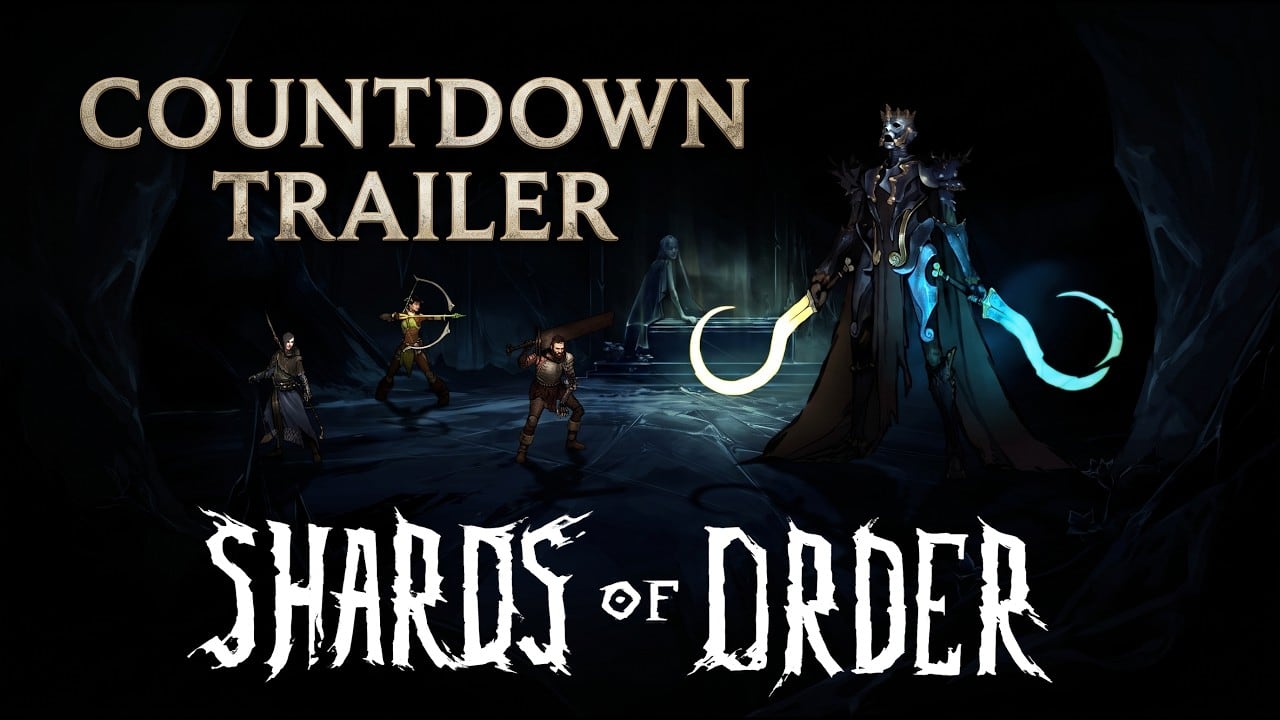
Combat in Shards of Order is the system’s sharpest break from genre norms. Fardust and Awaken Realms built a dark fantasy card RPG where fights are not divided into player turns and enemy turns, and where you never spend mana from a regenerating pool. Instead, a time counter runs the entire encounter: every card you play costs time, every draw costs time under specific rules, movement costs time, and enemy countdowns advance whenever you act. Understanding that single sentence unlocks the rest of this guide.
If you are brand new, read Getting Started first for demo scope and party structure. This page goes deep on timing, hand management, knockouts, and how combat interacts with the shared deck described in Deckbuilding.
No turns, no mana — what that actually means
Traditional card RPGs alternate sides or refund mana each turn. Shards of Order does neither. The battlefield is continuous: you choose cards and movement while enemies charge abilities on visible countdown timers. Playing a card consumes time from your budget and ticks those timers forward. Waiting is not free — inaction is rarely an option when countdowns reach zero.
There is no mana stat. Card costs are expressed in time (and occasionally other hero-specific resources like Soldier rage or Scholar mana types generated from ally damage). Exile adds another layer with four arrow slots that behave like limited special ammo. See Items and Cards for how gear modifies available actions.
The time counter and enemy countdowns
Think of time as the only currency that matters in a fight. When you play a card costing two time, you spend two units and every enemy countdown decreases by two (exact tick behavior should be verified in-game, but the design intent is synchronized pressure — your actions accelerate the enemy timeline).
Reading telegraphs: Before acting, scan which enemy ability reaches zero soonest. Sometimes spending extra time to kill a priority target is cheaper than eating a full countdown hit. The Boss Guide applies this discipline to demo bosses and the miniboss.
Movement costs one time per reposition. In cramped encounters, walking to adjacency before a finisher can delay your card sequence — factor movement into your arithmetic. Input details live on the Controls guide.
Draw rules: the three-card threshold
Hand refill is not free. Drawing costs time — unless you have already played three or more cards in the current sequence, in which case your next draw is free.
This rule shapes optimal pacing:
- Open with low-time cards when possible to build toward the free draw.
- Avoid early expensive draws that both spend time and advance every countdown.
- Chain three plays, draw for free, then evaluate whether to continue spending or stabilize.
Deck thinners and zero-time cantrips (if present in your injected gear pool) become premium for hitting the threshold efficiently. Simulate counts with the Deck Calculator when theorycrafting.
At launch, Fracture stacks make every redraw deal 6 damage per hero per stack (up to 18 at three stacks) — see Laws and Fracture. The demo teaches draw discipline that full release punishes harder on the redraw timer detailed below.
Shared party deck in combat
Three heroes — Soldier, Scholar, and Exile as the permanent launch roster — share one deck. Cards belong to the party, not an individual belt. Gear injects new cards into that shared pile, so combat options change when you equip armor or amulets mid-dungeon.
Implications:
- A defensive card added by armor helps whichever hero is targeted.
- Scholar setups that rely on ally damage require positioning and sequencing across heroes.
- Exile arrow consumption is party-wide resource management.
Build-specific synergies are covered in Builds and ranked on the Tier List.
Knockouts, crippled state, and revival
When a hero is knocked out, they enter a crippled state rather than leaving the fight permanently. Revival requires playing revive cards whose cost increases after repeated knockouts on the same hero. This is not permadeath — Shards of Order is a persistent RPG — but it is a snowballing tax on sloppy defense.
Practical recovery steps:
- Stabilize countdowns before reviving so the crippled hero is not immediately re-targeted.
- Consider Ethereal Power instead of revive spam when multiple heroes fall — see Ethereal Power.
- Carry revive-enabling cards added through gear when running risky routes on the Demo Map.
- After multiple knockouts, consider revisiting safer nodes rather than pushing a boss under crippled penalties.
Demo versus launch: redraw and queue
Launch reworks two systems demo players must unlearn.
Redraw timer at 4
Full release redraw timer starts at 4. When it hits zero, the party redraws from the shared deck — and under Fracture, each stack adds 6 damage per hero on that redraw. Reduction ties to time actually spent: a cost-3 card reduces the timer by 3, and movement costs 1 time while also reducing redraw by 1.
The demo favored cheap-card spam under older redraw rules. Launch pacing rewards deliberate time spending, not cycling low-cost cards to bypass the clock. Full breakdown: Redraw and Queue.
Combat queue sequencing
Launch lets you queue card sequences before animations finish, producing faster flow than demo stop-and-start. Queue defensive tools before rage spenders or Scholar finishers; coordinate Exile arrows after setup resolves. Queue commits still spend time and advance enemy countdowns when they resolve — they only remove dead air between decisions.
Read Demo Changes for the changelog and Launch Day for July 28, 2026 unlock at 6 PM CET.
Combat versus roguelite expectations
Because there is no procedural run generation and no permadeath wipe, combat losses hurt through tempo and knockout taxes, not save deletion. You can leave a fight, revisit gear nodes, adjust injections per Deckbuilding, and re-attempt with knowledge. The Demo Walkthrough shows where resting and backtracking mitigate bad fights.
Advanced pacing checklist
- Count time to lethal before playing your highest-cost finisher.
- Track whether you are one card away from a free draw.
- Include movement cost when planning multi-target sequences.
- Match Scholar mana generation to the cards you intend to play next.
- Monitor Exile arrow slots so you do not empty ranged options before boss phases.
Where to go next
Apply these rules on the Demo Walkthrough, study boss patterns in the Boss Guide, and read Redraw and Queue for launch redraw and queue rules. Laws and Fracture covers Fracture stack math. For a holistic demo opinion, see the Review guide. Launch unlocks July 28, 2026 at 6 PM CET on Steam PC — Launch Day checklist and Release Date details.
Frequently Asked Questions
Quick answers to the most common questions.
Does Shards of Order use turn-based combat?
No. Fights use a continuous time-counter system without alternating turns.
Is there a mana pool in combat?
No traditional mana. Cards cost time, and hero-specific resources like rage or Scholar mana types come from other rules.
When is drawing from my deck free?
After you play three or more cards in a sequence, your next draw costs no time.
How much time does movement cost?
Each movement action costs one time.
What happens when a hero is knocked out?
They enter a crippled state. Revive cards bring them back, but revive costs increase with repeated knockouts.
Do enemies act on their own turn?
Enemies use countdown timers that advance when you spend time playing cards, drawing, or moving.
How does launch redraw differ from the demo?
Launch uses a redraw timer of 4 with reduction tied to actual time spent on cards and movement. Demo cheap-card spam under older rules does not apply.
Can I queue cards before animations finish?
Yes at launch. The combat queue lets you plan sequences ahead for faster pacing than demo stop-and-start flow.